
Project#
The CPSC 100 project is a comprehensive assignment divided into five milestones, each focusing on exploring technology’s impact on relationships. The project provides a structured format for students to engage deeply with the course material and extend their study of some topics independently.
Overview#
There are five deliverables for the project, here’s a high-level summary of the deliverables:
Deliverable |
Weight |
Due Date |
|---|---|---|
Milestone 1 - Group Formation and Teamwork Contract |
2% |
Oct 14 |
Milestone 2 - Project Proposal |
5% |
Nov 3 |
Milestone 3 - Project Report (Individual Contribution) |
8% |
Nov 19 |
Milestone 4 - Digital Artifact (Group Contribution) |
8% |
Nov 28 |
Milestone 5 - Final Presentation & Peer Review |
2% |
Dec 5 |
Milestone 3 will be submitted individually; all other deliverables will be evaluated as a group (one submission and score for all group members).
We have spaced out the deliverables over the term to ensure that students have sufficient knowledge, preparation and time to complete each milestone.
You will be assessed based on the deliverables as well as your TA mentors’ and team members’ evaluations. At the discretion of the teaching team, individual students may receive a lower grade than other members of their group if they were not contributing to the group in an equitable manner.
Project Categories#
Your project should fit into one of the five broad categories below. There is still a lot of freedom for you to choose interesting things within these categories, but you must make sure it fits into exactly one of these categories. This also means that your area of exploration should be focused on only one of these categories so you can do a deep and meaningful exploration (and link it back to the course topics). Some of the topics may be covered in class and if they are, you are responsible for finding supplementary content outside of the class material for your project.
A. Generative AI and student learning#
Details and examples coming soon…
B. Technological inequality#
Details and examples coming soon…
C. Algorithmic Bias#
Details and examples coming soon…
D. Financial and Environmental impacts of technology#
Details and examples coming soon…
E. Technology and crime#
Details and examples coming soon…
Project Contract#
The table below shows the detailed requirements for each of the contracted grades:
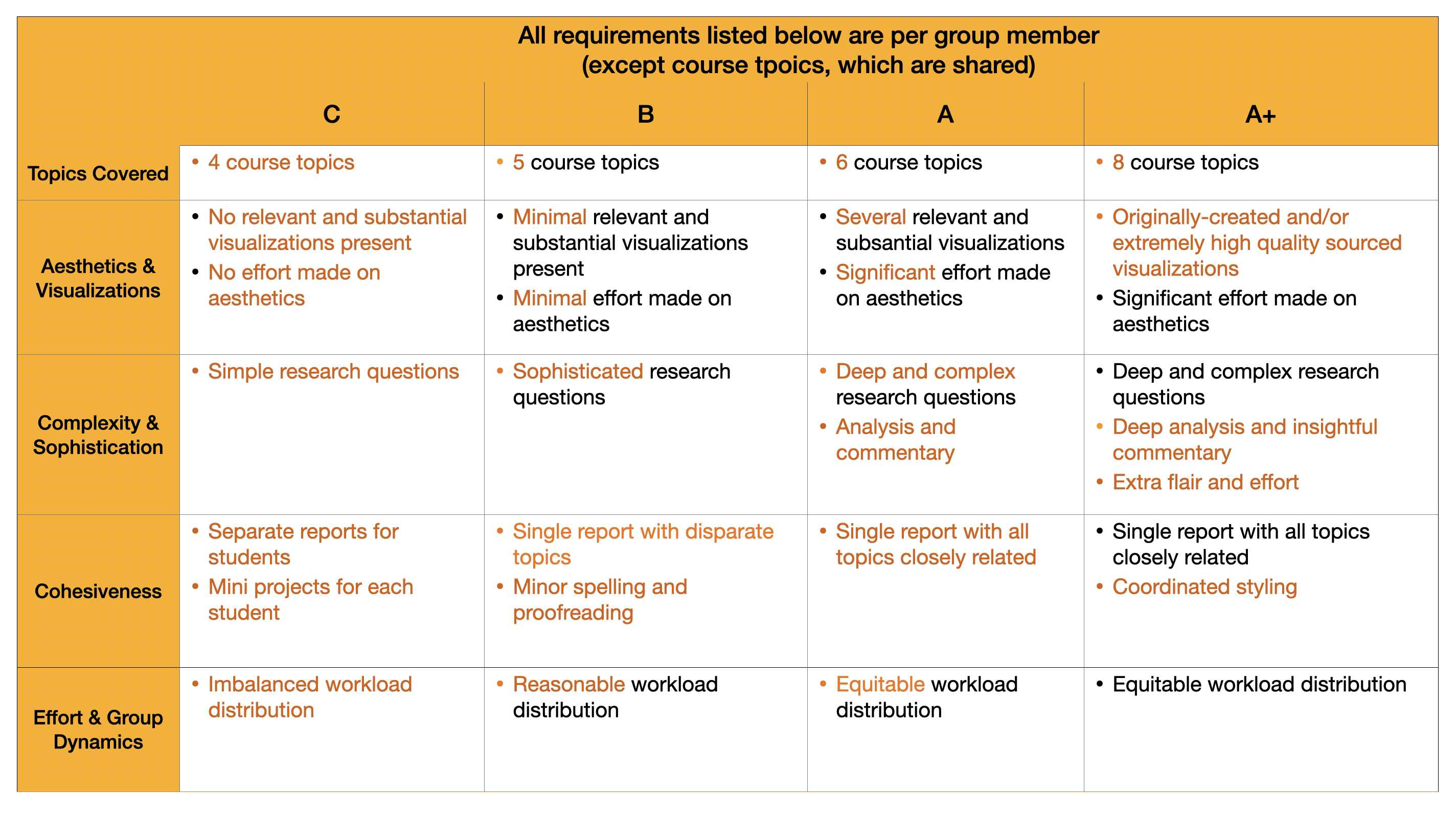
The next section has the full list of course topics you can choose from for the “Topics Covered” section.
Course Topics#
Computational Thinking
Algorithms
Computer Programming
Data Representation
Human Computer Interaction
Internet
Artificial Intelligence
Natural Language Processing & Large Language Models (LLMs)
Ethics and Computer Science
Social implications of Computing
Algorithmic Bias
Data Mining
Data Storage
Data Privacy
Data Security
Data Visualization
Other topics may be possible after discussion with the Instructor
Note that we are looking for meaningful and substantial exploration of the project category you chose (1 of 5) linking back to the course topics you choose from the list above (based on your contracted grade).
Logistics#
Group Formation#
Students will work in groups of three or four - you are encouraged to make groups in your lab sessions so it’s easier for you to find time to work together, but this is not required. The project is designed so that the effort required per student will be the same regardless of whether you’re in a 3-person group, or a 4-person group. Submitting work done by anyone outside of your group is NOT permitted and will be considered academic misconduct. The work you do should be your own group’s work, but references others (like cited quotations or resources, critical feedback, etc.) is highly encouraged!
Group Contract (Milestone 1)#
In this milestone, students will write the “group contract”, decide on working patterns, how to communicate, choosing a Contract Grade, etc…
Task: Students will develop a group contract that outlines the roles, responsibilities, and expectations for each group member. The contract will establish group norms, decision-making processes, communication strategies, and meeting schedules. It will also include a high-level overview of the group’s goals and aspirations, working styles, communication preferences, and processes.
Project Proposal (Milestone 2)#
In this milestone, students will put together a project proposal of their area of inquiry.
Students will:
Choose an area of inquiry that fits into one of the five broad themes (specified above),
Formulate specific questions to guide their exploration of the selected topic.
Identify at least three substantial online sources that will provide data or information relevant to their topic.
Research and Inquiry (Milestone 3)#
This milestone involves a detailed presentation of the articles they have summarized and data they have found related to their specific questions intended for fellow students in the CPSC 100 class…
Students will:
Delve into their research, summarizing the findings and examining how they address the questions they were interested in.
Create an outline for a digital artifact that will visually represent their findings.
Creating a Digital Artifact (Milestone 4)#
Students will:
Design a digital artifact based on their research and analysis.
This digital artifact should effectively summarize their main themes/findings from their research, presenting the information visually engaging and informative intended for fellow students in the CPSC 100 class.
Finalizing submission and feedback (Milestone 5)#
In this milestone, students will put the finishing touches on their digital artifact and give structured feedback to other groups about their digital artifact.
Resources for working in teams#
Though your TAs and instructors will be available to help you with difficult issues, we encourage you first to try to resolve problems with your partner through mature and active communication.
In the past, groups have broken down due to poor communication and decision-making strategies. Understanding the benefits of group work and creating a group charter can enhance group interactions.